About client
Our client is a leading Canadian provider of innovative IIoT hardware and software solutions for cathodic protection and pipeline integrity remote monitoring. Pipeline operators routinely inspect underground pipelines to detect corrosion and prevent failures. These inspections rely on cathodic protection systems, where electrical current is used to reduce corrosion risk in steel pipelines.
Its customers operate extensive underground pipeline networks across remote regions. To ensure safety and regulatory compliance, operators must periodically measure pipeline electrical readings, analyze corrosion indicators, and submit reports to regulatory authorities.
However, the traditional workflow was highly manual and time-consuming.
Why manual surveys were no longer sustainable
Pipeline corrosion monitoring requires frequent surveys across long distances. When the process relied on manual recording and paper workflows, several operational challenges emerged.
- Survey readings were captured on paper, creating avoidable transcription errors and rework.
- Data handoffs were manual, requiring physical delivery and operator re-entry into systems.
- Inspection routes were time-intensive, with technicians walking long distances between stations while logging readings by hand.
- Reporting workflows were delayed, since multiple surveys had to be compiled and reconciled after the field work.
- Manual calculations slowed risk visibility, delaying early detection of potential corrosion issues.
From Manual Surveys to Automated Pipeline Integrity Monitoring Platform
| Before |
After |
|
Field surveys relied on paper forms and manual logging, making readings slow to capture and easy to misplace.
|
Survey readings are captured directly from field hardware into a mobile app via Bluetooth, eliminating paper-based capture.
|
|
Technicians covered kilometers between test stations, manually reading instruments and writing values down at each stop.
|
Technicians trigger readings in-app while the system auto-records values and waveforms, reducing manual effort in the field.
|
|
Operators had to re-enter survey data into systems after collection, increasing transcription errors and rework.
|
Data flows from the mobile app to a centralized cloud platform, creating a cleaner handoff and more consistent datasets.
|
|
Compliance reporting required compiling multiple surveys after the fact, slowing regulatory submissions and decision cycles.
|
Surveys are consolidated in the platform to support faster, more streamlined compliance reporting for regulators.
|
Solution: Digitizing corrosion monitoring with cloud and mobile platforms
To address these challenges, the integrity products manufacturer partnered with Saviant to build a custom product - a next generation digital ecosystem platform for cathodic protection and integrity workflows.
The solution consists of two integrated systems:
1. Mobile Application for field data capture:
Technicians or surveyors carry tablets running the mobile app during pipeline inspections. The app connects to the client’s hardware instruments (multimeters) using Bluetooth Low Energy (BLE). This allows the application to:
- Capture electrical readings directly from the device
- Record waveform data associated with pipeline current
- Automatically calculate key corrosion monitoring parameters
- Generate survey reports after readings are collected
Technicians now simply trigger readings in the app rather than manually recording measurements.
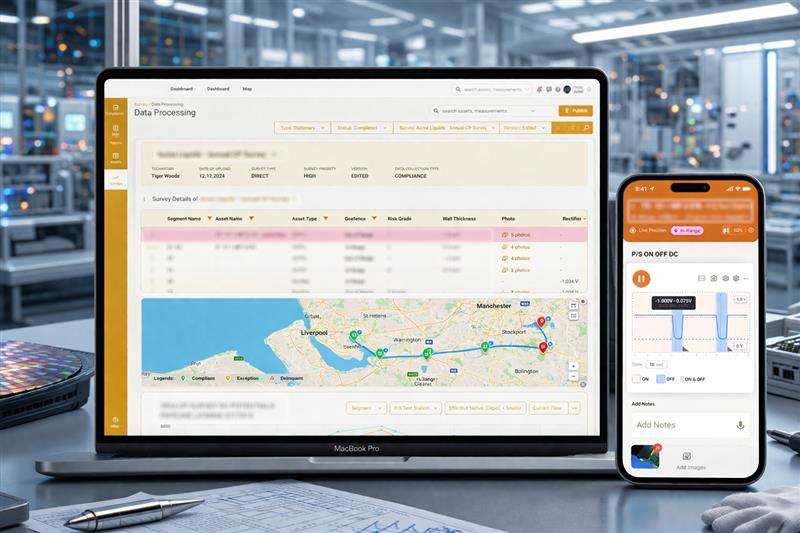
2. Web application for survey management through AWS Cloud platform
The cloud-based web application acts as the command center for inspection workflows. Developed using Angular on AWS, the web application is used by operators to -
- Create and assign surveys to field technicians
- Track survey locations using coordinates
- Import collected field data
- Aggregate survey results across pipelines
- Generate regulatory compliance reports
Survey data collected in the field is synchronized back to the platform, allowing operators to review and analyze readings across multiple inspection sites.
Technology foundation
The platform was built using technologies aligned with the client’s existing architecture.
The mobile application integrates with field hardware devices through Bluetooth connectivity (BLE), enabling real-time capture of pipeline electrical measurements.
Saviant’s engagement approach: Built for measurable impact from day one
The transformation wasn’t a full-scale overhaul - it was a targeted digitization effort. By identifying where manual effort and delays occurred in pipeline inspection workflows, Saviant focused on solving the most critical operational bottlenecks first.
- 01 Started with value design
Saviant worked with the client team to understand the inspection workflow, define the value proposition for end customers, and identify the features that would deliver the most operational impact.
- 02 Defined the architecture for scale
A cloud-based platform and mobile application architecture was designed to integrate hardware devices, field data capture, and centralized reporting.
- 03 Built what mattered first
The first phase focused on digitizing the survey workflow - capturing field readings, automating calculations, and generating digital reports.
- 04 Shipped the MVP and validated adoption
The solution was deployed as an MVP, allowing the client to demonstrate the platform to customers and begin onboarding early users.
- 05 Planned for what comes next
A one-year roadmap was established with quarterly feature releases, including enhanced survey types and deeper cloud connectivity between field devices and the platform.
Current adoption and roadmap
The solution has been deployed in production, and the first customer has been onboarded. The client is now:
- Demonstrating the platform at industry forums and conferences
- Onboarding additional customers in upcoming quarters
- Expanding the product with new survey capabilities
- Enhancing cloud connectivity for field data synchronization
Future roadmap discussions also include exploring predictive analysis capabilities for pipeline integrity insights.
The impact so far
- 1 customer onboarded post-MVP production deployment (with another planned next quarter)
- 6-month compliance reporting cycle supported through structured survey aggregation and reporting workflows
- Digital capture of corrosion monitoring data directly from field hardware
- Field workflow digitized to reduce manual logging while covering long inspection routes
- Centralized management of inspection workflows and survey assignments
- A scalable cloud platform ready for expanded analytics capabilities
By digitizing pipeline inspection workflows and integrating hardware data capture with a cloud platform, the company transformed corrosion monitoring from a manual reporting process into a connected digital workflow. This platform now provides the foundation for safer pipeline operations, faster reporting cycles, and future innovation in pipeline integrity management.