For many multifamily organizations, the biggest decisions are rarely blocked by a lack of data. They’re blocked by how that data is used - how budgets are built, how forecasts are defended, how rents are set, and how teams explain changes portfolio-wide without spending weeks in spreadsheets.
That’s where this customer success story begins.
About client
A US-based analytics provider in the multifamily real estate space had built a strong early offering around dashboards. Portfolio teams could finally visualize performance and share reporting more consistently. But as adoption grew, one truth became unavoidable: visibility was not the same as operational control. The moment teams needed to act - build next-year budgets, forecast expenses, price units, and explain variance - work shifted back into Excel, manual review cycles, and experience-led decision-making.
The client didn’t need “better dashboards.” They needed decisioning workflows.
Challenges with traditional dashboard reporting
In the early stage, dashboards delivered value through insight. But as the customer base expanded, the platform hit the limits of a reporting-first model:
- Annual budgeting and forecasting often took weeks because planning still relied on manual Excel workflows.
- Forecast outputs lacked traceability - teams could see the number, but not the drivers behind it.
- Rent-setting depended on instinct and limited market signals, increasing the risk of missed pricing opportunity.
- Customer-to-customer variability (definitions, rules, terminology) made standardization difficult, leading to manual intervention in reporting cycles.
- Daily ETL feeds became a single point of dependency - when upstream data slipped, downstream decision cycles stalled.
The result was a platform that could show what happened but struggled to support how teams needed to operate every day.
From dashboards to a multi-product SaaS suite for multifamily real estate businesses
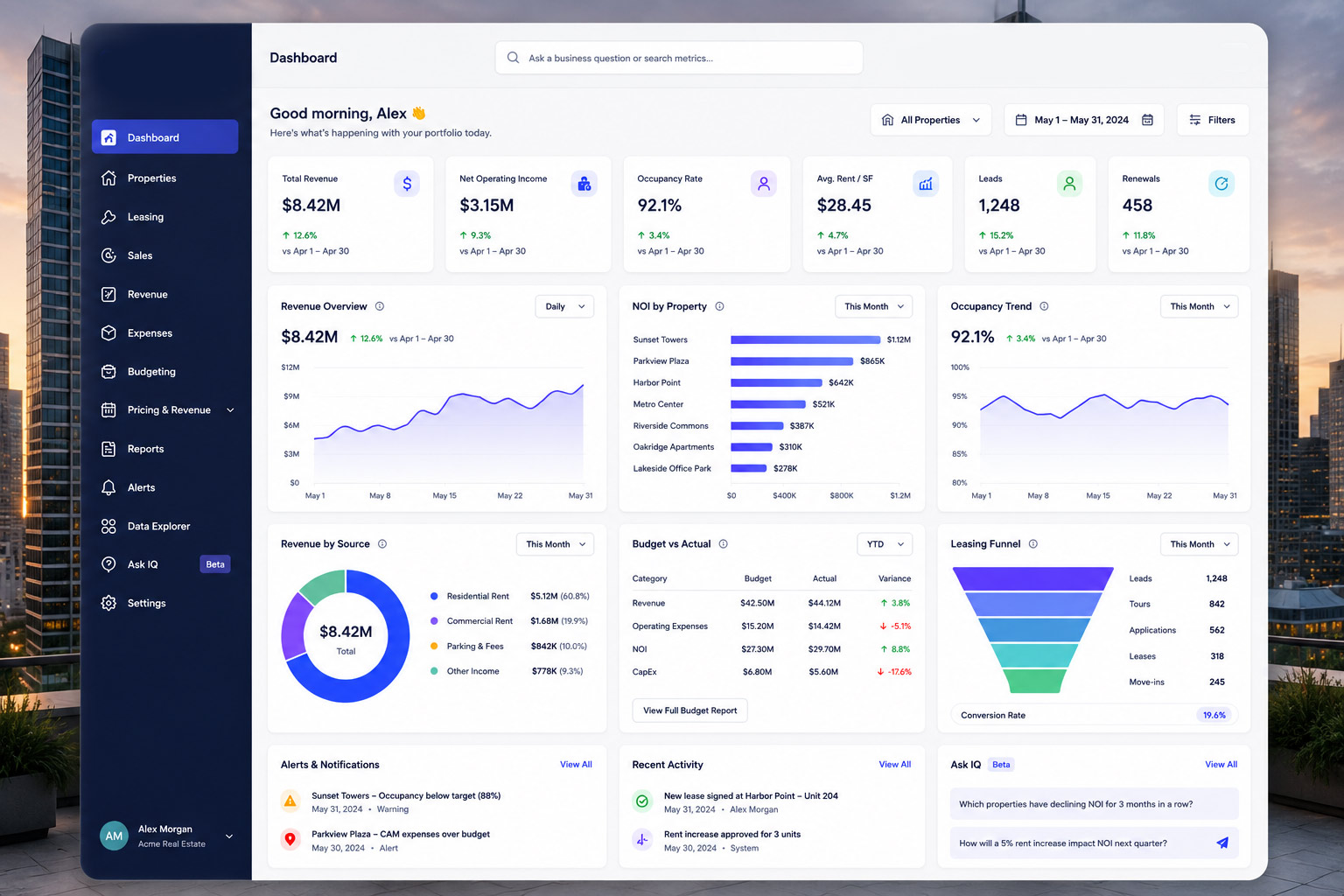
Saviant partnered with the client to evolve from dashboards into a multi-product SaaS suite aligned to the highest-friction portfolio workflows. Instead of attempting a “big bang” overhaul, the roadmap expanded in phases - each tied to adoption, time-to-value, and repeatable user workflows.
The suite focused on three pillars that directly map to how property management teams work:
- Budgeting & forecasting: Moving planning out of Excel and into a product workflow designed for portfolio scale. This reduced spreadsheet fragmentation and helped accelerate planning cycles. The outcome was a forecasting capability that became near instant (< 1 minute), enabling teams to iterate faster and make planning less dependent on manual reconciliation.
- Rent optimization: Rent-setting is one of the most consequential workflows in multifamily - and one of the most vulnerable to subjective judgment. The platform evolved to support algorithm-assisted rent recommendations grounded in market and regulatory inputs, improving consistency and supporting profitability-driven decisions.
- Business intelligence: BI didn’t disappear - it matured. The platform strengthened the insight layer by improving data traceability and reducing the manual overhead required to maintain consistent reporting across a growing customer base.
How Saviant delivered value-first roadmap execution
The engagement was shaped by SaaS consulting experts using Saviant’s value-first approach - sequencing delivery around adoption levers and faster time-to-value.
- Started with value design: The roadmap prioritized the highest-impact use case to move beyond dashboard-only visibility. The goal was clear: launch the first SaaS workflow that directly supported day-to-day portfolio decisions.
- Built only what mattered first: Saviant formed a joint team with flexible ramp-up/ramp-down aligned to the six-month roadmap. This approach accelerated delivery while keeping capacity tied to release priorities - enabling the launch of an MVP Budgeting application that replaced spreadsheet-heavy planning.
- Piloted with the right customers: Early releases were stabilized with 3–4 customers, validating the end-to-end workflow and proving the system could handle larger data volumes outside Excel - before scaling broader adoption.
- Product launch and upgrades: As adoption grew, the platform moved through iterative releases that strengthened performance, reliability, and user experience - ensuring the suite could expand without slowing execution.
- Planned for what comes next: The roadmap expanded into additional product that leverages the client’s proprietary Rent Engine - turning the platform into a multi-product decisioning ecosystem rather than a single workflow tool.
- And the next wave is already in motion: AI embedded across the suite, alongside UX modernization, to enable faster data retrieval and more real-time intelligence for portfolio teams.
The outcome: Scale, readiness, and a platform built to grow
The shift from dashboards to multi-product SaaS decisioning supported a major growth outcome: the platform scaled onboarding from 4 customers to 50 in the span of 2 years, strengthening investor readiness and supporting a successful Series B raise. In parallel, the platform delivered the operational outcomes that make scale sustainable - faster planning cycles, more consistent pricing decisions, and stronger traceability.
Most importantly, the client didn’t just add new capabilities. They built a foundation for what comes next: expanding modules, increasing adoption, and embedding AI-driven insights into daily portfolio workflows.
Because in multifamily, the goal isn’t simply to see the numbers. It’s to plan, price, and explain performance - with confidence - at scale.