- Home
- Blog
Quotation Automation AI Agent for Construction: From Vendor Paperwork to Cost Intelligence
Shivam Srivastav | Published Date: 11th Oct 2026
 Praful Dandgawal
|
Article Blueprint
Construction estimators lose hours reading vendor quotations before they can compare a single price. Capturing and classifying a 100-price quote by hand takes more than 90 minutes. Here’s how Saviant built a quotation automation AI agent for construction on Microsoft Azure that does this work automatically. Instead of handing a whole quotation to one large language model, which skips or invents prices on long documents, the agent works page by page. It separates real unit prices from totals and allowances, then classifies each price against the company's own cost history using retrieval-augmented generation (RAG). Every price gets a confidence score, so estimators review only the exceptions.
Reading vendor quotations eats the estimator’s week
Consider a large real estate, construction and infrastructure company running many projects at once. Each project is built from dozens of trade activities like foundations, earthwork, precast, fireproofing, steel, interiors and more. Each activity goes out to several vendors for a quotation. Before anyone picks a vendor, someone has to read every quotation that comes back.
That reading is where the real cost of construction pricing hides.
A single quotation can hold a handful of prices or well over a thousand. They sit in clean tables, dense paragraphs and multi-page sections, mixed in with totals, lump sums and allowances that have to be separated from genuine unit prices. Capturing one real price (vendor, section, description, quantity, unit and unit price) and filing it correctly takes an experienced estimator roughly a minute. A single quotation with a hundred prices can take well over ninety minutes to process for one vendor, on one activity, on one project. Multiply that across every vendor, activity and live project. Who is left to actually compare the prices? Here, the answer was nobody; a team of skilled estimators spent its week transcribing numbers instead.
The problems compound from there:
- Volume. A construction company can typically receive dozens of quotations a day across different trades and projects, each one requiring careful, line-by-line review.
- Manual data entry. Every genuine price still has to be keyed into a system and tagged against a long list of parameters before it becomes usable for cost analysis.
- Missed prices. Numbers buried mid-paragraph get skipped and a skipped price never reaches the vendor comparison.
- Specialized cost classification. Once captured, every price still must be filed into the company's historical cost categories, a skill that takes years to build. A new hire starts from zero and can’t be fast-tracked.
From manual review to AI agent for construction workflow
Saviant’s AI Agent development team built an AI agent for construction quotations on Microsoft Azure to take on exactly this work. It runs continuously at scale.
The obvious first idea is to hand an entire quotation to a large language model and ask for every price. It breaks down fast. It works for a short document with a couple of dozen prices. Past that, the model runs out of context and starts skipping entries. Worse, it can invent prices that were never in the source. For a system that feeds a cost database, a confidently wrong answer is worse than a missing one.
So, the quotation automation AI agent breaks the work into smaller stages, each one checkable on its own:
- Every incoming document or vendor invoice (PDF, Excel, Word, HTML or Markdown) is stripped of layout noise and converted into clean, page-marked Markdown by Azure AI Content Understanding, so each price stays traceable to the page it came from.
- Dedicated AI agents pull out the key facts like vendor, project, date and quotation type. Azure OpenAI then matches them to the customer's own project and vendor records.
- The same agents identify which pages actually carry pricing, so no time is spent processing cover pages, terms or boilerplate.
- Specialized Azure AI Foundry agents then work through the pricing pages one at a time. Each agent keeps its own conversation thread, so a thousand-line quotation never gets squeezed into a single request.
- A verification step separates genuine unit prices from totals, lump sums and allowances that would otherwise distort the cost data.
- Verified prices are normalized, structured and stored automatically in Azure SQL, ready for use.
The whole sequence runs on an event-driven backbone of Azure Durable Functions (Azure’s service for long, multi-step jobs that can pause and resume), Storage Queues and Blob and Table Storage. That makes the pipeline resumable by design: if a stage fails or a document turns out to be enormous, processing continues exactly where it stopped instead of starting over.
Extraction is only half the job. Classification needs the company’s own history
Every price still needs to land in the right historical cost category, normally the work of a seasoned estimator. Instead of relying on an AI model's general knowledge, we ground each decision in the customer's own history. Every price the estimators have already classified is indexed in Azure AI Search and converted into embeddings (numeric fingerprints of meaning) with Azure OpenAI. New prices are then matched through hybrid retrieval, which weighs similar meaning and keyword relevance together. This is Retrieval-Augmented Generation (RAG) used as a guardrail: the model chooses from real precedent rather than guessing, and our code verifies that its answer is genuinely one of the retrieved records.
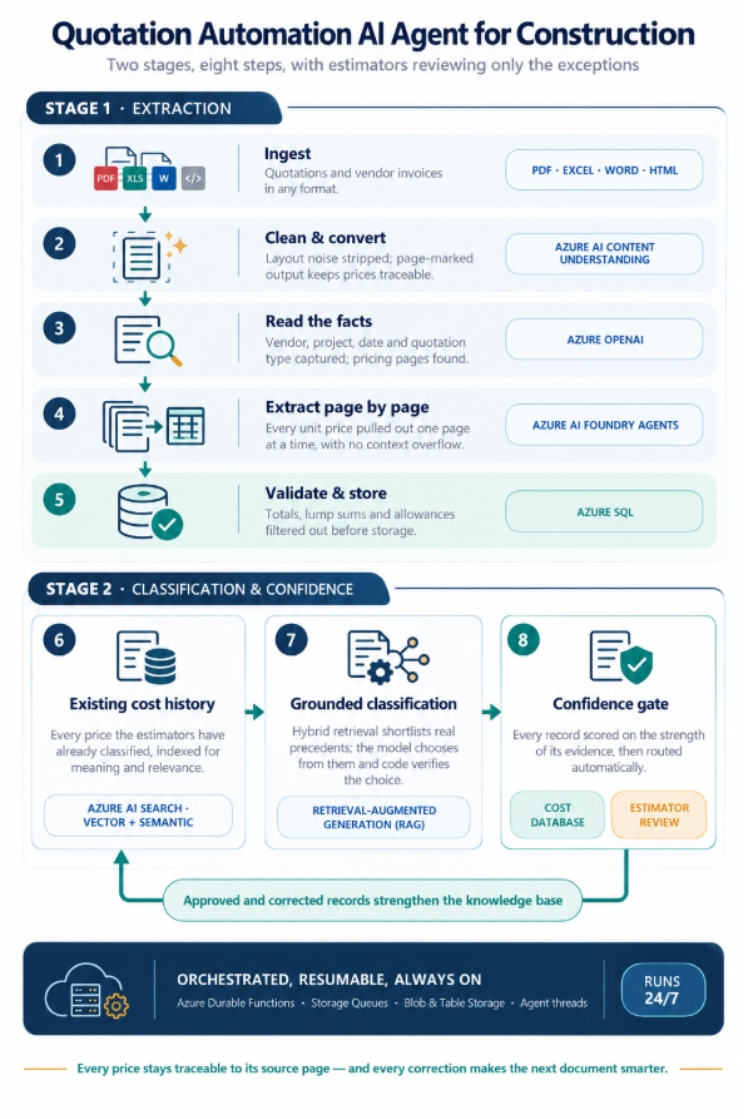 How the quotation automation AI agent for construction works end to end
Quality control built into every price
Automation only earns trust when it is accountable. Every extracted and classified price carries a confidence score, built from how clearly it appeared in the source and how closely it matches historical precedent. High-confidence records flow straight into the cost database. Anything below the bar goes to an estimator for a quick review. Their correction feeds back into the search index, so the next classification is a little sharper. Estimators stay in the loop. They just stop typing and start judging.
The result: Estimators now spend their time on vendor decisions, not data entry
A hundred-price quotation that took an estimator more than ninety minutes now processes automatically, across every document type and vendor. Estimators no longer spend their days extracting and filing prices. They spend their time comparing vendors, negotiating better terms and awarding work with confidence. Every number stays traceable back to the page it came from. Every number traces back to its source page, and each processed quotation adds to a cost history the company can actually query.
How many quotations did your estimators read this week, and how many did they actually compare? A quotation automation AI agent for construction changes that ratio: faster turnaround, fewer missed prices and cost data that sharpens with every correction.